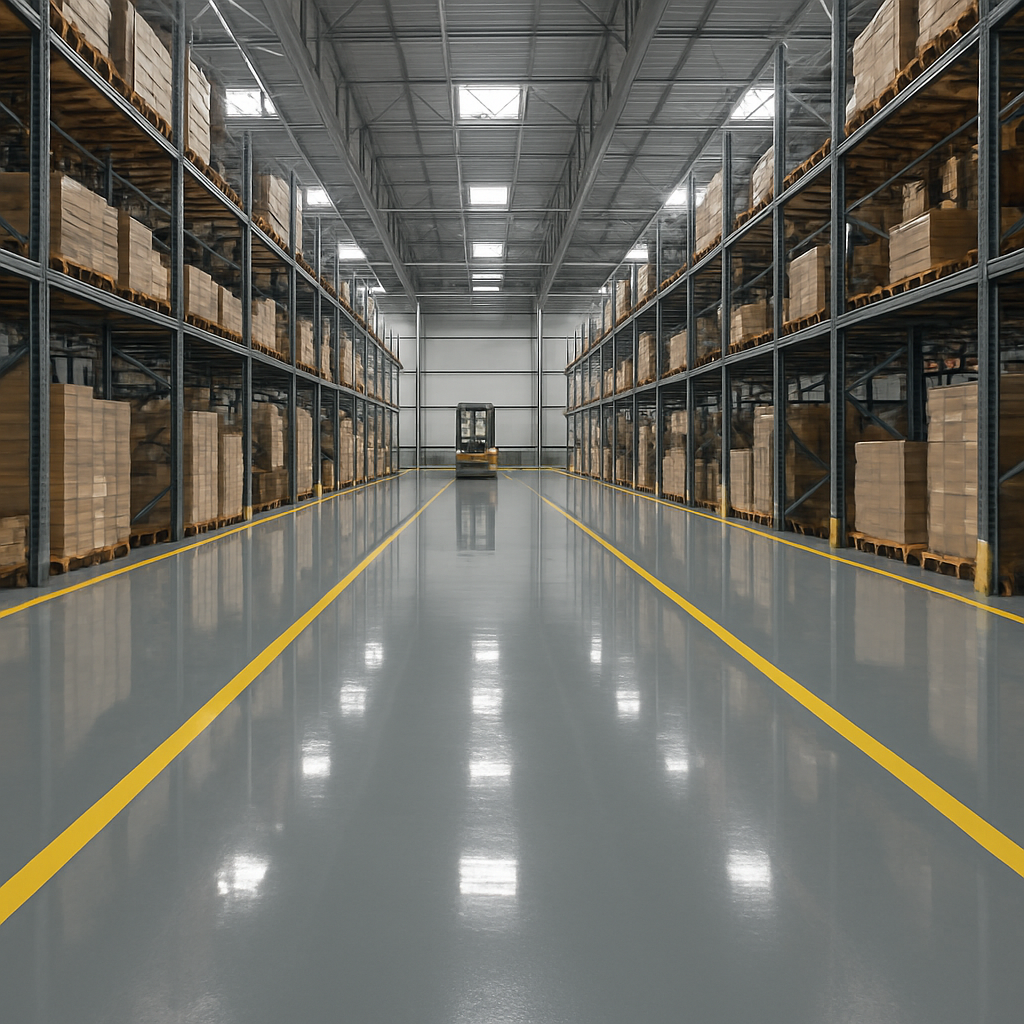
Warehouse Epoxy Flooring
Warehouse epoxy flooring is a heavy-duty resin floor system engineered to withstand forklift traffic, heavy point loads, and constant abrasion in distribution, manufacturing, and storage facilities. We install high-build epoxy and polyaspartic warehouse floors across Fort Collins and Northern Colorado — complete with safety line striping, moisture mitigation, and fast-cure scheduling that gets your operation back online with minimal downtime.
Build
Up to 60 mil
Cure
12–24 Hrs
Traffic
Forklift
Warranty
Up to 20yr
[ 01 ] — Overview
Industrial floors built for forklift abuse.
A warehouse floor is one of the hardest-working surfaces in any business. Forklifts, pallet jacks, steel-wheeled carts, and heavy racking subject it to abrasion and point loads that grind bare or sealed concrete to dust — creating airborne silica, damaging product, and forcing constant repairs. A properly engineered warehouse epoxy floor eliminates that: a seamless, high-build coating that resists abrasion, impact, chemicals, and the relentless traffic of a working facility.
We spec warehouse systems by the load. Light-traffic storage areas may need a standard epoxy build, while high-traffic forklift lanes and manufacturing floors get a full high-build polyaspartic system up to 60 mils with an aggressive diamond-grind or shot-blast prep and, where needed, moisture mitigation to stop hydrostatic pressure from delaminating the coating. Everything is matched to your actual operation.
Safety and organization are built in. We lay down OSHA-compliant line striping, walkways, hazard markings, and color-coded zones directly into the coating system, so they won't peel up like surface paint. The result is a floor that's safer, easier to clean, and dramatically cheaper to maintain than bare concrete over its lifespan.
[ 02 ] — Where It Fits
Industrial spaces we coat
Every facility is different — we engineer the buildup, slip profile, and markings to match your traffic and product.
Distribution & Logistics
Abrasion-resistant floors with striped forklift lanes and pedestrian walkways for high-throughput facilities.
Manufacturing Floors
Chemical- and impact-resistant systems engineered for machinery, point loads, and production traffic.
Cold Storage
Moisture-mitigated, thermal-shock-resistant coatings that perform in refrigerated and freezer environments.
Fleet & Maintenance Bays
Oil-, fuel-, and hot-tire-resistant floors that stand up to vehicles, lifts, and service work.
Food & Beverage Production
Seamless, sanitary, USDA-friendly surfaces with slip texture for wet processing and washdown areas.
Aircraft Hangars
Large-format, fuel-resistant, high-gloss systems that handle aircraft loads and look the part.
[ 03 ] — Why It Works
Built to perform, engineered to last
Engineered for heavy loads
High-build polyaspartic systems up to 60 mil are spec'd for forklifts, pallet jacks, and concentrated point loads.
Fast return to service
Fast-cure chemistry and off-shift scheduling get production lanes back in operation in as little as 12–24 hours.
Built-in safety markings
OSHA-compliant line striping, walkways, and hazard zones are integrated into the coating so they never peel up.
Eliminates concrete dust
Sealing the slab stops the silica dusting that bare concrete sheds under traffic — protecting product and air quality.
Moisture mitigation
We test for and address hydrostatic moisture so the coating won't bubble or delaminate over time.
Lower lifetime cost
A seamless, repair-resistant floor costs far less to maintain than bare concrete that's constantly patched and ground.
[ 04 ] — Recommended Systems
Coating systems we spec for industrial floors
[ 05 ] — The Process
How the project runs
01
Facility assessment
We evaluate traffic, loads, moisture, and chemical exposure, then engineer a system spec and phased schedule.
02
Aggressive prep
Heavy floors get a diamond grind or shot blast, plus crack, joint, and moisture remediation for a permanent bond.
03
High-build install
We install the primer, body coat, and high-solids wear coat, then lay in line striping and safety markings.
04
Phased return to service
Fast cure lets us hand back sections as they're finished, so your operation keeps moving throughout the project.
[ 06 ] — Local & Trusted
Serving Northern Colorado
We coat warehouses, distribution centers, and manufacturing facilities throughout Northern Colorado, including Fort Collins, Loveland, Greeley, Windsor, and the surrounding I-25 corridor. As a local industrial contractor, we work around your shifts, meet your safety requirements, and deliver floors built for Colorado's temperature swings and the demands of a 24/7 operation.
Service Areas
[ 07 ] — Questions
Warehouse Epoxy Flooring FAQ
- How much does warehouse epoxy flooring cost?
- Industrial warehouse floors typically run $4–$10 per square foot depending on the system buildup, slab condition, moisture mitigation, and square footage — and large facilities cost less per foot. Because the spec varies so much by traffic and load, we quote each facility after an on-site assessment.
- Can epoxy flooring handle forklift traffic?
- Yes — when it's engineered for it. We install high-build polyaspartic systems up to 60 mil over an aggressively prepped slab, which are designed specifically for forklifts, pallet jacks, and heavy point loads. The key is matching the buildup to your actual traffic.
- Do you install line striping and safety markings?
- We do. We integrate OSHA-compliant forklift lanes, pedestrian walkways, hazard zones, and color-coded markings directly into the coating system, so they're far more durable than surface-applied floor paint.
- How do you handle moisture in a warehouse slab?
- We test for hydrostatic moisture before coating. Where it's present, we install a moisture-mitigation primer that relieves vapor pressure so the finished floor won't bubble, blister, or delaminate — a common failure point on slab-on-grade industrial floors.
- Can you coat our warehouse without shutting down operations?
- Almost always. We phase large facilities and work around your shifts, finishing and handing back sections one at a time. Fast-cure polyaspartic means a coated area can be back under traffic in as little as 12–24 hours.